
Transferring Tokens with Canton Daml: State and Authorization Compared with Solidity
- whackur
- Blockchain
- October 15, 2026
When Alice sends all 100 token units to Bob, Bob becomes the person who can spend them next. The Solidity example updates balances by address; the Daml example for Canton consumes Alice’s holding contract and creates Bob’s. They express the same transfer outcome with different units of state and different authorization checks.
Read More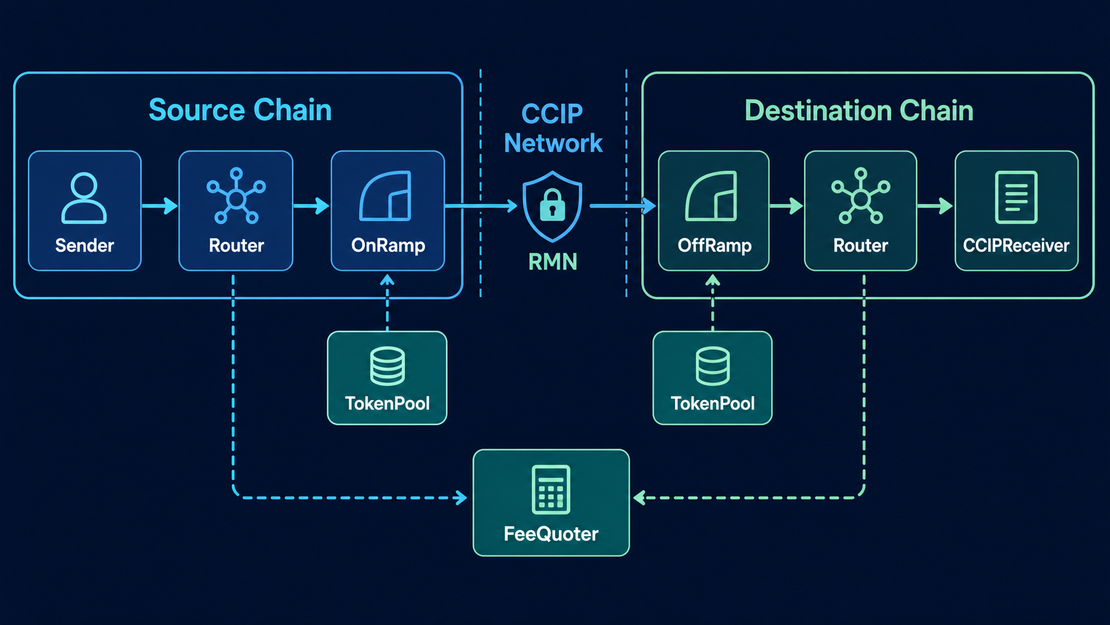
Chainlink CCIP EVM Contracts: Architecture from Source Code
- whackur
- Blockchain
- June 30, 2026
EVM chains are isolated by design. A contract on Arbitrum has no native way to call a contract on Base, and sending USDC from Ethereum Mainnet to Polygon is not a built-in operation. Cross-chain bridges filled that gap for years, but the category has seen repeated security incidents that highlight how wide the attack surface is.
Read More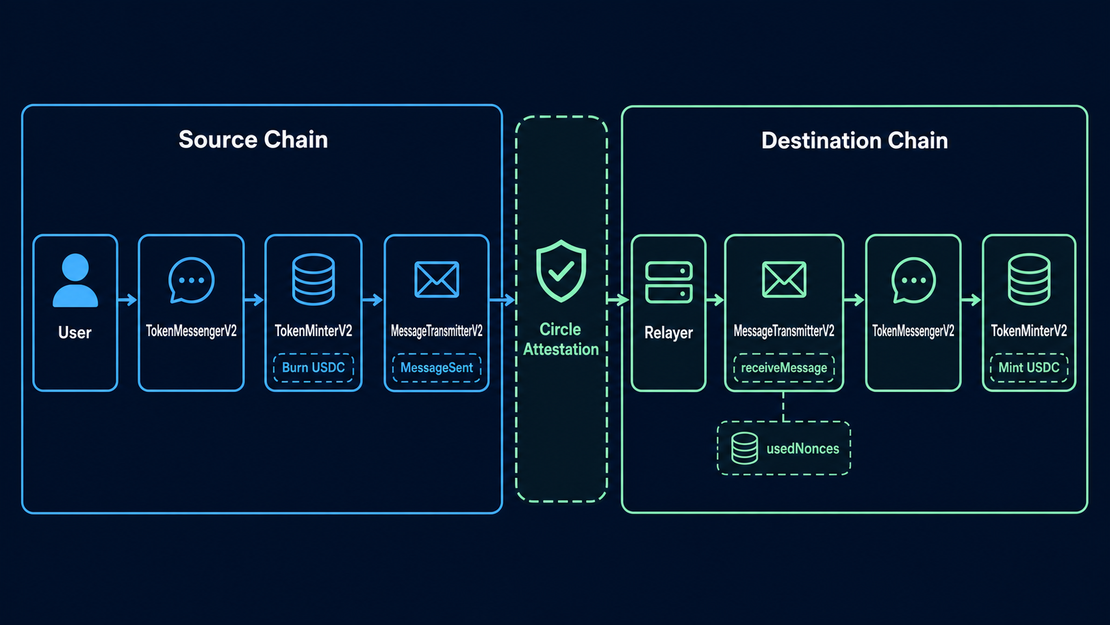
Circle CCTP V2 EVM Contracts: A Source-Code Walkthrough
- whackur
- Blockchain
- June 30, 2026
Bridge designs for moving USDC between chains come down to two families. Lock-and-mint parks the original token in a contract on the source chain and issues a wrapped version on the destination. Burn-and-mint destroys the token on the source chain outright and issues the same amount fresh on the destination. Circle’s CCTP (Cross-Chain Transfer Protocol) is the second kind.
Read MoreTags
- A2a
- Act
- Agent
- Agent-Debate
- Agent-Finance
- Agent-Harness
- Agent-Skills
- Agentic-Payments
- Ai-Agent
- Ai-Agents
- Ai-Architecture
- Ai-Blockchain
- Ai-Research
- Ai-Search
- Ai-Security
- Akash
- Anthropic
- Apify
- Base
- Benchmark
- Besu
- Bitcoin
- Bittensor
- Block-Access-Lists
- Canton
- Capital-Markets
- Ccip
- Cctp
- Chainlink
- Circle
- Coding
- Coding-Agent
- Coinbase
- Commerce
- Competition
- Compliance
- Context-Engineering
- Cross-Chain
- Cryptography
- Daml
- Data
- Data-Enclosure
- Data-Licensing
- Decentralized-Compute
- Depin
- Dex
- Diffusion-Policy
- Distillation
- Eip
- Eip-2780
- Eip-3009
- Eip-8037
- Eip-8038
- Emergent-Behavior
- Ensemble
- Enterprise-Blockchain
- Epbs
- Erc-8001
- Erc-8004
- Erc-8041
- Erc-8126
- Erc-8183
- Erc-8196
- Erc-8226
- Ethereum
- Evals
- Evaluation
- Evm
- Execution-Client
- Fhe
- Fido2
- Fintech
- Gas
- Glamsterdam
- Goldman-Sachs
- Google-Cloud
- Gpt-5-6
- Groth16
- Harness
- Heloc
- Hermes-Agent
- Identity
- Imitation-Learning
- Institutional-Finance
- Kimi
- Knowledge-Management
- Kya
- Langfuse
- Langgraph
- Lerobot
- Llama-Cpp
- Llm
- Llm-Agents
- Llm-as-Judge
- Llm-Observability
- Local-Llm
- Maci
- Math
- Mcp
- Memory
- Metadata
- Mev
- Moa
- Model-Routing
- Moe
- Mpp
- Mtp
- Multi-Agent
- Observability
- Okf
- Onchain
- Open-Source
- Open-Standard
- Opik
- Orderbook
- Passkey
- Physical-Ai
- Platforms
- Post-Quantum-Cryptography
- Post-Training
- Privacy
- Prompt-Engineering
- Provenance
- Python
- Qbft
- Quant-Finance
- Quantum-Computing
- Qwen
- Rag
- Reasoning
- Reinforcement-Learning
- Render
- Reputation
- Retrieval
- Reverse-Kl
- Rl
- Robot-Learning
- Rwa
- Search-Agent
- Security
- Self-Improvement
- Semaphore
- Settlement
- Skills
- Small-Language-Model
- Smart-Contract
- Smart-Contracts
- Smolvla
- Snark
- Software
- Solidity
- Sp1
- Stablecoin
- Stigmergy
- Swe-Bench
- Tokenization
- Tracing
- Trading
- Tutorial
- Ucp
- Uncensored
- Usdc
- Validators
- Vla
- Voting
- Wallet
- Webauthn
- X402
- Ylds
- Zero-Knowledge
- Zk-Proof
- Zk-Rollup