
Why did Anthropic publish its report on alleged Kimi-to-Claude routing?
If sensitive information was reaching Claude, why would Anthropic reveal the route? A model provider may gain more from limiting unauthorized use and alerting customers to a data-handling problem than from continuing to observe the inputs. Answering a competitor’s users consumes compute and may produce training material for that competitor. Publication also reaches users and enterprise buyers whom account bans alone cannot inform. These incentives explain why disclosure can make sense; they do not establish how Anthropic made its internal decision.
Read More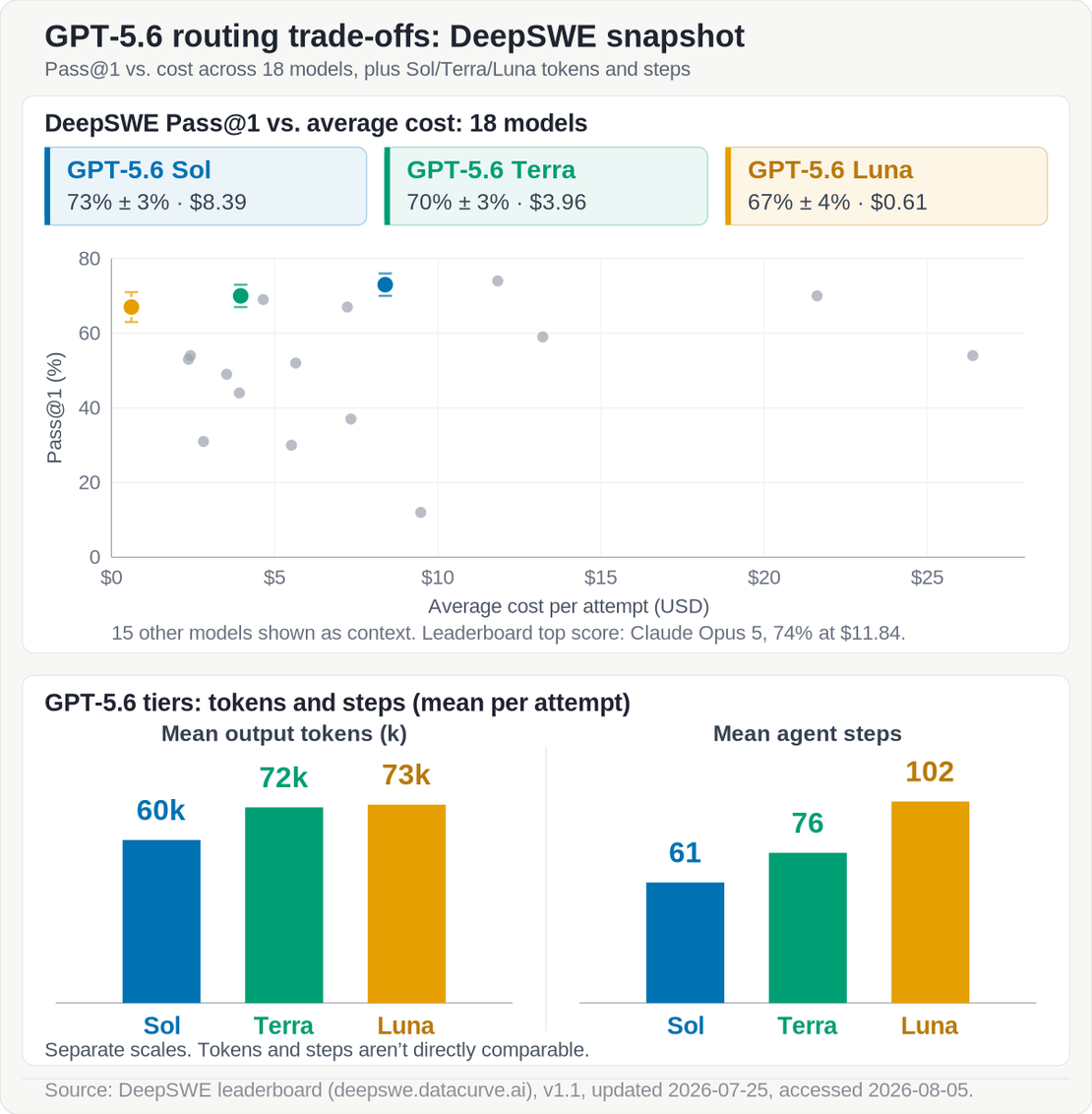
GPT-5.6 Sol, Terra, and Luna: A Model Routing Guide for Coding Agents
A claim like “Luna Max beats Terra High” circulates around GPT-5.6 discussions, and it does not hold up. Sol, Terra, and Luna are separate models, each a different capability tier. Max, high, xhigh, and ultra are settings within a given model that control how much reasoning time it uses and how many agents run in parallel. Collapsing a tier name and a settings name into one ranking compares two different axes as if they were one.
Read More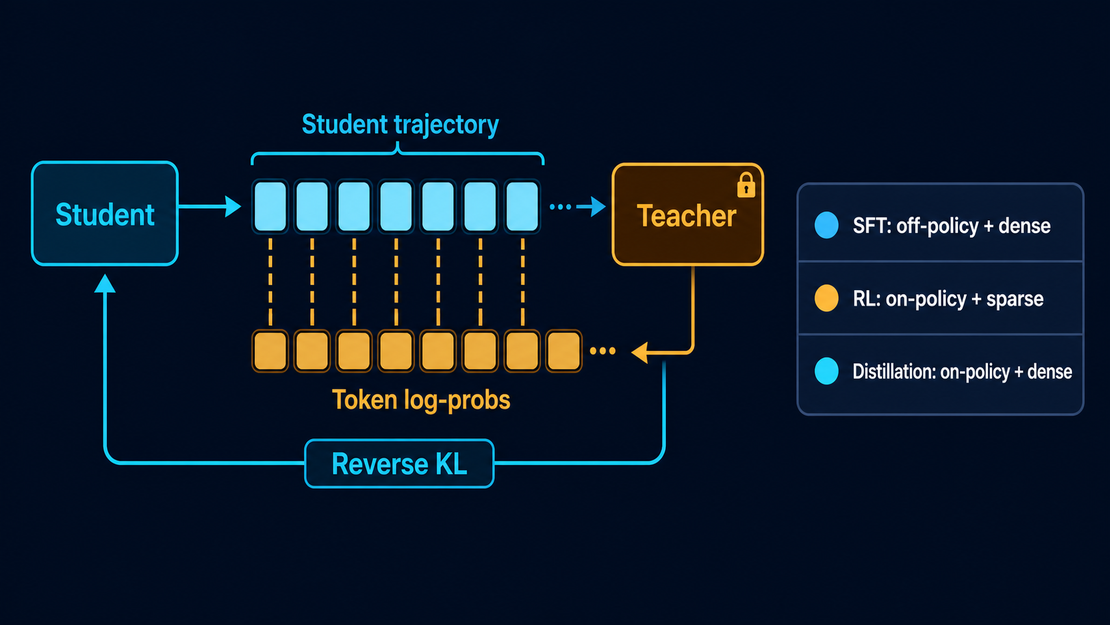
On-Policy Distillation: Closing the Gap Between RL and SFT
The two standard post-training methods each leave a gap. Supervised fine-tuning (SFT) has the student imitate sequences a teacher already produced, but training happens on states the student may never actually visit, so errors compound over long generations. Reinforcement learning (RL) samples from the student’s own rollouts, which fixes that mismatch, but the reward is usually a single bit or two per episode. A post Thinking Machines Lab published in October 2025 proposes combining the two: sample trajectories from the student, then have a strong teacher score every token in that trajectory.
Read More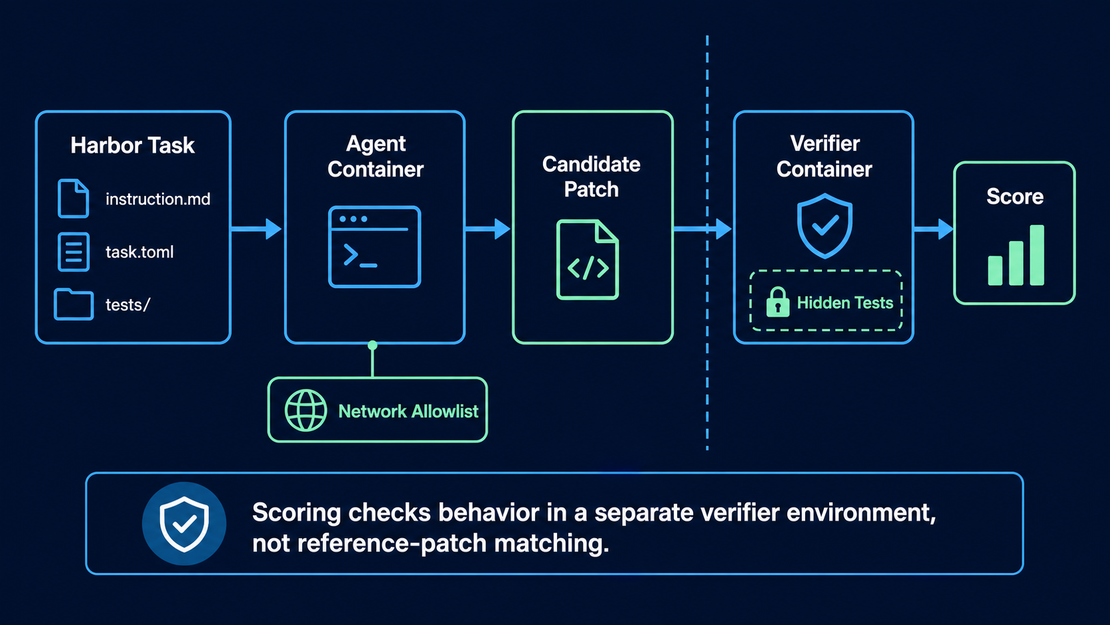
DeepSWE: A Benchmark for Long-Horizon Coding Agents
SWE-bench has been the default coding-agent leaderboard for a while, but it has well-known weaknesses. Most tasks come from existing public issues and PR patches, so a high score might partly reflect memorization. Most tasks are also single-file bug fixes, which is not representative of the multi-file, long-horizon work that a coding agent does in practice.
Read More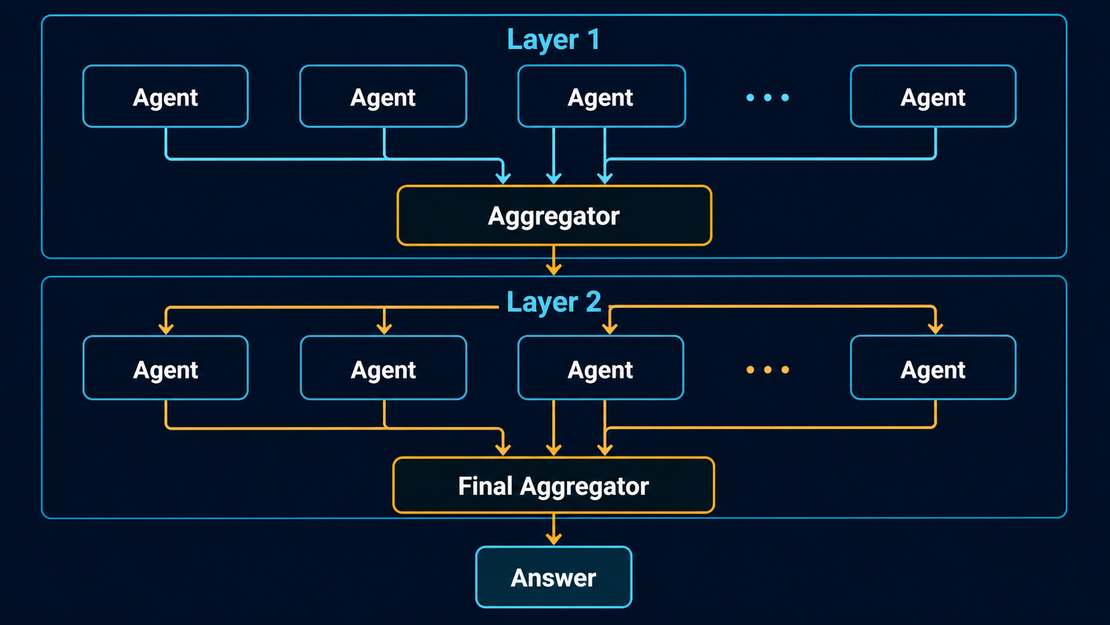
Mixture of Agents: How Layering Open-Source LLMs Beat GPT-4 Omni
Instead of scaling a single model up, you can stack multiple models in layers and have each one refine the previous layer’s output. Together AI’s research team formalized that approach in June 2024 as Mixture of Agents (MoA) in arXiv:2406.04692. Using only open-source models, their MoA configuration scored 65.1% on AlpacaEval 2.0, versus 57.5% for GPT-4 Omni.
Read More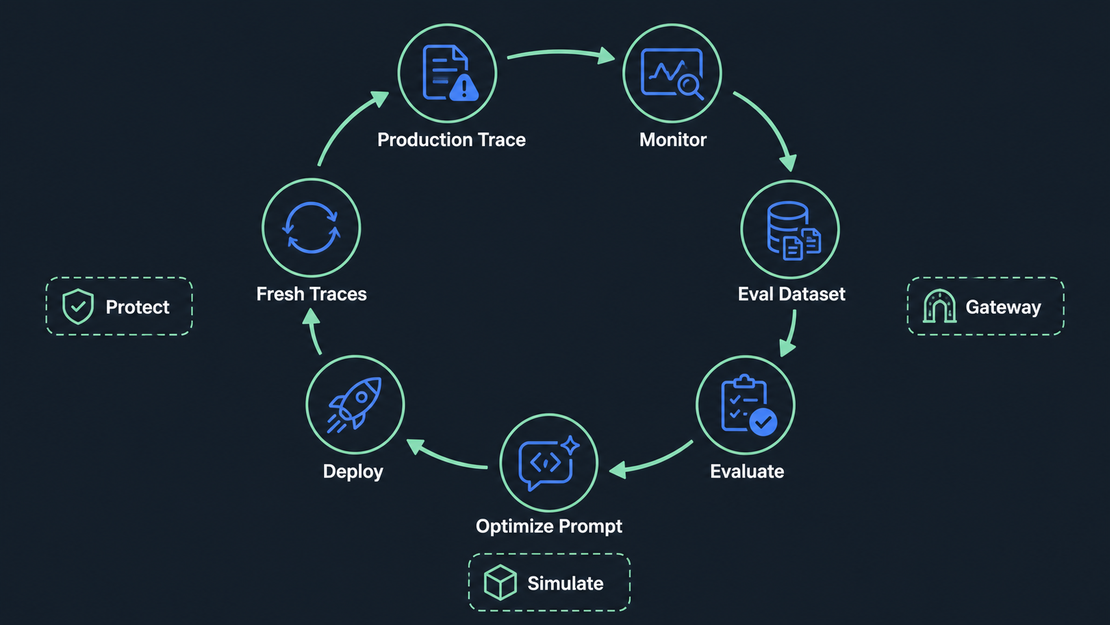
Future AGI: Evaluate, Observe, and Improve AI Agents in One Place
If you have shipped an AI agent, this will sound familiar. The demo runs fine. Then it hits production, the hallucinations start, and you can’t tell what went wrong or why. So you bolt on one tool for evals, another for tracing, another for guardrails. The real problem is that none of them talk to each other, so the loop you need to actually fix things never closes.
Read MoreTags
- A2a
- Act
- Agent
- Agent-Debate
- Agent-Finance
- Agent-Harness
- Agent-Skills
- Agentic-Payments
- Ai-Agent
- Ai-Agents
- Ai-Architecture
- Ai-Blockchain
- Ai-Research
- Ai-Search
- Ai-Security
- Akash
- Anthropic
- Apify
- Base
- Benchmark
- Besu
- Bitcoin
- Bittensor
- Block-Access-Lists
- Canton
- Capital-Markets
- Ccip
- Cctp
- Chainlink
- Circle
- Coding
- Coding-Agent
- Coinbase
- Commerce
- Competition
- Compliance
- Context-Engineering
- Cross-Chain
- Cryptography
- Daml
- Data
- Data-Enclosure
- Data-Licensing
- Decentralized-Compute
- Depin
- Dex
- Diffusion-Policy
- Distillation
- Eip
- Eip-2780
- Eip-3009
- Eip-8037
- Eip-8038
- Emergent-Behavior
- Ensemble
- Enterprise-Blockchain
- Epbs
- Erc-8001
- Erc-8004
- Erc-8041
- Erc-8126
- Erc-8183
- Erc-8196
- Erc-8226
- Ethereum
- Evals
- Evaluation
- Evm
- Execution-Client
- Fhe
- Fido2
- Fintech
- Gas
- Glamsterdam
- Goldman-Sachs
- Google-Cloud
- Gpt-5-6
- Groth16
- Harness
- Heloc
- Hermes-Agent
- Identity
- Imitation-Learning
- Institutional-Finance
- Kimi
- Knowledge-Management
- Kya
- Langfuse
- Langgraph
- Lerobot
- Llama-Cpp
- Llm
- Llm-Agents
- Llm-as-Judge
- Llm-Observability
- Local-Llm
- Maci
- Math
- Mcp
- Memory
- Metadata
- Mev
- Moa
- Model-Routing
- Moe
- Mpp
- Mtp
- Multi-Agent
- Observability
- Okf
- Onchain
- Open-Source
- Open-Standard
- Opik
- Orderbook
- Passkey
- Physical-Ai
- Platforms
- Post-Quantum-Cryptography
- Post-Training
- Privacy
- Prompt-Engineering
- Provenance
- Python
- Qbft
- Quant-Finance
- Quantum-Computing
- Qwen
- Rag
- Reasoning
- Reinforcement-Learning
- Render
- Reputation
- Retrieval
- Reverse-Kl
- Rl
- Robot-Learning
- Rwa
- Search-Agent
- Security
- Self-Improvement
- Semaphore
- Settlement
- Skills
- Small-Language-Model
- Smart-Contract
- Smart-Contracts
- Smolvla
- Snark
- Software
- Solidity
- Sp1
- Stablecoin
- Stigmergy
- Swe-Bench
- Tokenization
- Tracing
- Trading
- Tutorial
- Ucp
- Uncensored
- Usdc
- Validators
- Vla
- Voting
- Wallet
- Webauthn
- X402
- Ylds
- Zero-Knowledge
- Zk-Proof
- Zk-Rollup