SwarmWorld: LLM Agents That Cooperate Without Talking, and Technology That Outlives Them
Table of Contents
In SwarmWorld, agents can continue one another’s work without talking by observing persistent devices and changes to their shared environment. That shared world helped them build collections of technologies serving several functions, but did not guarantee the best individual device. The MIT researchers’ paper demonstrates collaboration through accumulating functional artifacts inside a specified simulator. It does not establish the invention of real materials or a universal advantage for real-world multi-agent systems.
Agents leave functional world state behind
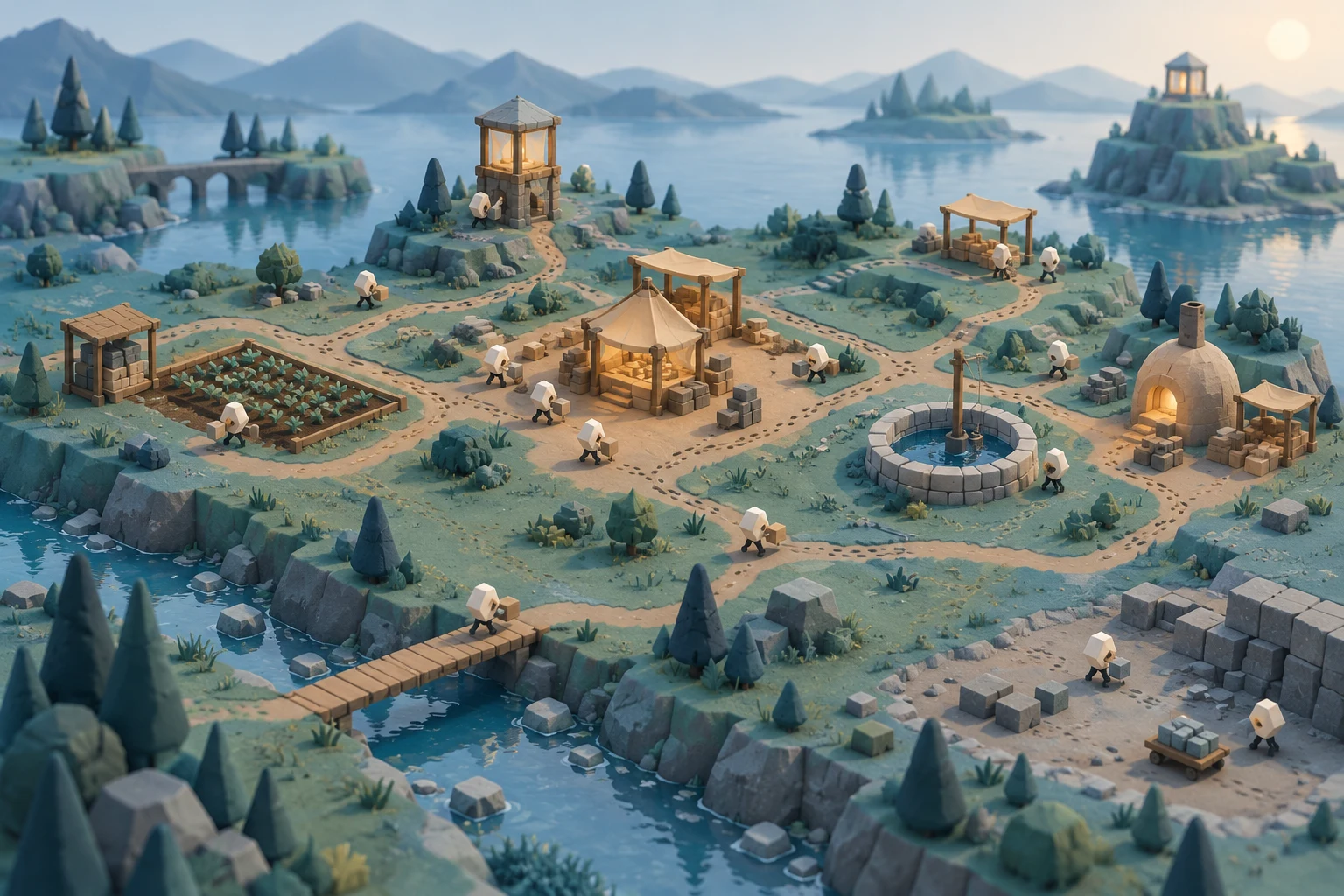
Subhadeep Pal, Fiona Y. Wang, and Markus J. Buehler gave agents with the same model and initial capabilities a mission to develop bioinspired material systems for environmental resilience. BioFoundry, the default environment, is a 72×54-cell grid. Terrain, resources, and processing facilities occupy different locations; fields such as moisture, temperature, and contamination change across space and time. Agents gather local resources, choose processing recipes, fabricate small material batches, and test them. They can use tested materials to construct persistent devices, called artifacts, and install controller programs. A deterministic simulator decides whether actions are legal and what happens. A device’s name or a claim that it removes contamination has no physical effect by itself. (Methods S2.1 to S2.4)
Agents do not read the entire map at once. They receive local observations, private memory of earlier experience, and whatever shared records their experimental condition permits. The paper used gpt-5.6-luna, temperature 0.7, and low reasoning effort, without role-specific prompts. One decision can plan up to 12 actions, but execution attempts only one action per agent per tick. A tick is a simulation time step, not an LLM call. The environment and artifacts keep updating between decisions. (Methods S2.1 and Algorithm 1)
An artifact controller is a restricted program rather than arbitrary Python. It uses 16 registers and 1 to 64 instructions to read local moisture or artifact state and request operations such as water collection, healing, or changes in opening fraction. It has no loops, file access, or network access. Requested effects remain constrained by available resources and simulator rules. The public programs.py confirms this instruction set and its limits.
One agent’s work therefore changes another agent’s input. Harvesting changes resource availability; an installed artifact becomes observable and may alter its surroundings. Another agent uses that state to decide which resources to use or what to do next. This indirect coordination through the environment is stigmergy. It can operate without conversation, provided agents can read and modify shared state and leave persistent consequences. (Methods S2.5)
Removing conversation and code inheritance separately
The researchers compared four conditions to distinguish the shared world’s effects from explicit knowledge transfer. “No communication” and “no explicit culture” are different interventions. (Figure 3 and Table S2)
| Condition | Routes for using another agent’s work |
|---|---|
| Full culture | Shared world and artifacts; messages, public records, teaching, trade, task claims; program reuse and forking (creating a modified descendant of an existing program) |
| No communication | Removes transfer through messaging, publication, and related channels, but retains reuse and forking of physically observed executable programs |
| No explicit culture | Also removes cross-agent program inheritance, the skill library, and access to author-written artifact descriptions. Physical properties and environmental consequences remain observable |
| Independent search | Runs N separate one-agent worlds and selects the highest result for each endpoint |
The independent baseline does not select one fixed winning agent. Different agents can win on artifact performance, resilience, and invention count, and winners can change across checkpoints. The society competes with this endpoint-wise best-of-N envelope. Corresponding agents received matched initial positions and scheduled decision opportunities, but token consumption was not held equal. Shared records can lengthen inputs, so this is not a comparison of efficiency at equal cost. (Methods S2.6 to S2.8)
The population study combined N=50, 100, and 200 with four conditions and four world seeds (random seeds used to reproduce the initial world), producing 48 episodes lasting 800 ticks each. Grid size stayed fixed, so population growth also increased density. A separate long-horizon study ran N=100 for 3,200 ticks under full culture, no explicit culture, and independent search, with four seeds per condition. The independent replication unit is the world seed: hundreds of agents are not hundreds of independent experimental samples. (Research design and statistical methods)
Evaluation stops further agent intervention
Artifact usefulness is measured separately from agents’ self-assessments. The checkpoint world is cloned and tested under eight unseen disturbance schedules for 288 ticks each. Contamination, drought, and storm locations and timings change while physics and installed programs continue, without agent actions or additional LLM calls. The paper calls this an agent-removal assay. In the public code, _run_agent_free_assay advances the simulator with an empty action mapping at every step. (Figure 3 and Methods S2.7 to S2.9)
Resilience here is neither a real-world lifetime measurement nor a safety certification. The evaluator finds the highest current function for each service, including water capture, remediation, and structural support, then scores their average magnitude and balance. Portfolio resilience measures how evenly the collection supplies those services; it does not simply add up artifacts. Held-out resilience averages this score over evaluation time and disturbance schedules. “Outliving their creators” thus means providing function during a 288-tick assay without further agent intervention. (Evaluation definition and implementation)
Portfolios and the best device produce different winners
These are the four-seed means at the final 3,200-tick checkpoint. Figure 14 was cross-checked against the released seed-level endpoint table. Scores are normalized simulator-defined measures. The final row measures the best device in the final state, rather than its historical peak.
| Endpoint, N=100 at 3,200 ticks | Full culture | No explicit culture | Independent best-of-100 |
|---|---|---|---|
| Portfolio resilience | 0.2474 | 0.2365 | 0.1794 |
| Held-out resilience | 0.0437 | 0.0446 | 0.0356 |
| Validated invention count | 5.75 | 7.00 | 2.75 |
| Best final-state artifact performance | 0.2380 | 0.3280 | 0.3488 |
A “validated invention” is more than a named idea. It must meet the gates for tested material, a complete design description, an agent-authored program, performance, and behavioral novelty. Fractional invention counts result from averaging the four worlds. (Methods S2.9)
The outcomes distinguish the objectives of collaboration. Shared worlds led on collections supplying several services, while independent search led on the best final individual device. Full culture also did not beat no explicit culture on every endpoint. Their held-out resilience ranking changed across the long-horizon checkpoints and ended close to a tie. In the shorter population study, discovery-performance rankings changed with N as well. The paper’s “bounded swarm advantage” includes these differences across metrics, times, and conditions. (Figures 4 and 13 to 14)
Diffusion starts with observation, and activity roles change
In the long-horizon study, a noncreator reused 99.3% of full-culture artifacts and 96.9% of no-explicit-culture artifacts at least once. Median time to first reuse among reused artifacts was 5 and 8 ticks, respectively, and approximately 95% of first reuse began with direct observation in both conditions. Reuse includes noncreator observation, causal reference, programming, or repair. The 95% figure does not mean that agents copied or improved those devices. Direct contact between the inventor and first adopter was not consistently enriched against a timestamp-shuffled comparison either. The records show that first contact with technology usually occurred through world observation; they do not establish that explicit communication had no influence on the wider process. (Figure 20 and glossary)
Code inheritance has a separate evidentiary basis. Where forking is enabled, an agent must know the parent program and change at least one instruction. Program-content hashes and parent-child records distinguish executable descent from a claim to have inherited someone’s idea. At tick 3,200, the mean of the seed-level maximum lineage depths reached 9.75 under full culture. Observation-led diffusion and executable inheritance are distinct processes that can coexist. (Figure 15 and public fork validation)
Division of labor also describes measured activity rather than assigned professions. After execution, researchers grouped movement, artifact proximity, and task actions into constructor/operator, artifact-local caretaker, cultural coordinator, and mobile surveyor states. In long-horizon full culture, the constructor/operator fraction rose from 0.008 in the first 200-tick window to 0.535 in the last. The same agent could move between states. Classification is partly affected by interventions that prohibit coordination behavior, however. The paper therefore also tested differentiation after removing communication-related features and still found distinctions between mobile exploration and artifact-local work. These findings do not establish human-like professional identities or intentions. (Figure S4 and Methods S2.10)
Changing worlds does not replace physical validation
The volcanic materials environment AshenRealm also supported collaborative construction and executable inheritance. Its resources, objectives, and scoring differ, so raw scores cannot establish relative difficulty against BioFoundry. Protein Realms, a protein-material environment, is a narrower feasibility test. It offers 12 predefined sequence variants, with hidden properties supplied by fixed simulator priors. It does not demonstrate unrestricted generation of new proteins or biochemical experimental validation. (Sections 2.8 to 2.9)
In that N=50, 800-tick, single-seed pilot, only no communication and the selected independent-search member completed the assay required to construct persistent installations. Full culture and no explicit culture did not. This demonstrates an executable exploration, processing, testing, and installation workflow under a different material representation; it is not a replicated basis for ranking the conditions. The technology illustrations in paper Figure 24 likewise explain proposed architectures rather than showing manufactured objects or molecular-structure predictions. (Figure 24)
What the public code and data allow readers to check
As of October 16, 2026 (KST), arXiv lists v1, submitted August 26, 2026 at 17:45 UTC, and the official SwarmWorld repository and Hugging Face dataset are accessible. The code contains the simulator, configurations, replay tools, and tests. Approximately 8.4 GB of data, including the 60 analyzed paper episodes and independent-search member records, is distributed separately. The source release uses Apache-2.0, and the Python package and command retain the name biofoundry for compatibility. (README and data guide)
Inspecting public source revision 6af7ae9 and calculating averages from the released summary tables do not establish an independent reproduction of the full LLM experiments. The data uses engine revision 9, and exact replay requires a compatible engine. Generated paper reports and figure pipelines are excluded from the current source release, so the paper’s description of the internal repository must also be distinguished from the public software package. (Release provenance and compatibility)
The useful design question is how to validate what agents leave behind. A system can separately measure how shared work reaches another agent’s observations, what artifacts do without further LLM intervention, and whether it optimizes coverage across functions or the best single result. Applying that design to files, databases, or robots requires new tests under those environments’ permissions, resources, and failure conditions. Four seeds, one model configuration, and synthetic physics cannot predict a general advantage for real collaboration.
Further reading
- SwarmWorld full paper and supplementary methods: condition definitions, metrics, and the evidence behind diffusion and activity-role analyses.
- Official analysis guide: procedures for small runs and released-data analysis.
- Dataset card: study file layout and trace-inspection examples.
References
- SwarmWorld, arXiv:2608.26081v1: Pal, Wang, and Buehler. Submitted 2026-08-26; accessed 2026-10-16 KST.
- SwarmWorld public source: revision used for code inspection; accessed 2026-10-16 KST.
- SwarmWorld released data: revision used for data checks; accessed 2026-10-16 KST.