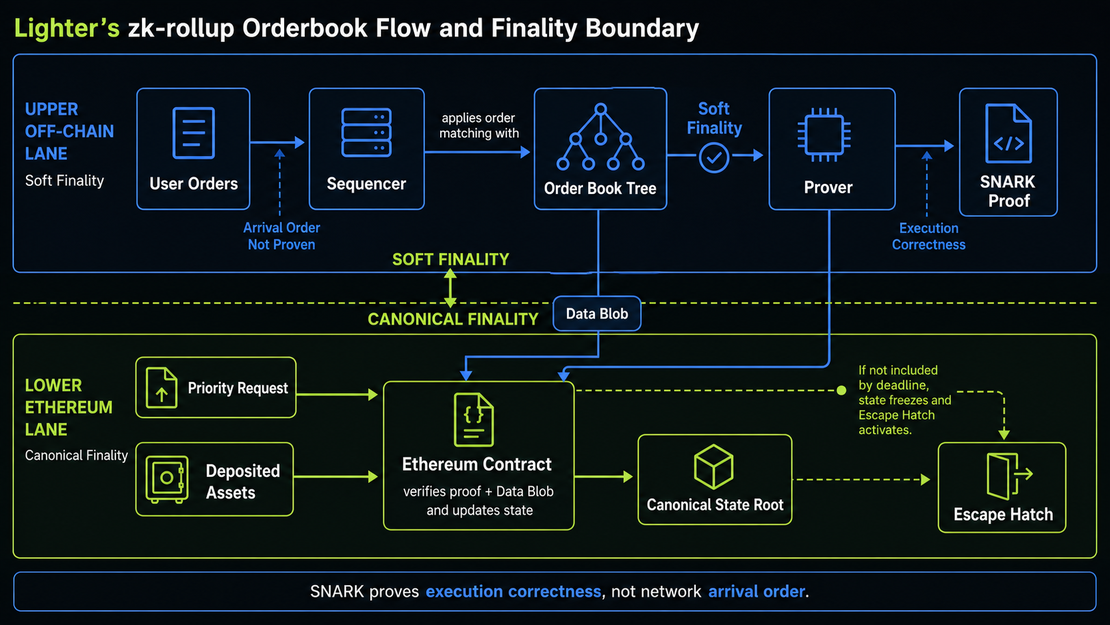
Lighter: A ZK-SNARK Orderbook DEX on Ethereum
- whackur
- Blockchain
- June 30, 2026
- Updated: August 31, 2026
Table of Contents
Decentralized exchanges come in two main forms. AMMs (Automated Market Makers) like Uniswap set prices algorithmically from pool ratios and work as permissionless swap venues. Orderbook DEXes match individual buy and sell orders by price and time priority, the same way centralized exchanges like Binance or Coinbase operate. Orderbooks enable limit orders, tighter spreads with active market-making, and more precise price discovery. AMMs do not.
Building a functioning orderbook on Ethereum runs into two problems immediately. First, processing thousands of order placements, cancellations, and matches per second as individual on-chain transactions means gas costs and block time delays that no market maker can work around. Second, MEV (Maximal Extractable Value): validators and block builders who see pending order flow can front-run individual trades by inserting their own transactions ahead of incoming orders.
A zk-rollup changes the equation. Order processing runs off-chain in a fast sequencer. A prover then generates a cryptographic proof, specifically a SNARK (Succinct Non-interactive Argument of Knowledge), that the processing followed the published matching rules. An Ethereum smart contract verifies that proof and settles the canonical state. Users do not have to trust the sequencer operator directly: the proof attests that the rules were followed.
Lighter applies this design to an orderbook DEX. A sequencer handles low-latency execution, a prover generates SNARK proofs for exchange operations, and Ethereum smart contracts verify those proofs and hold deposited assets.
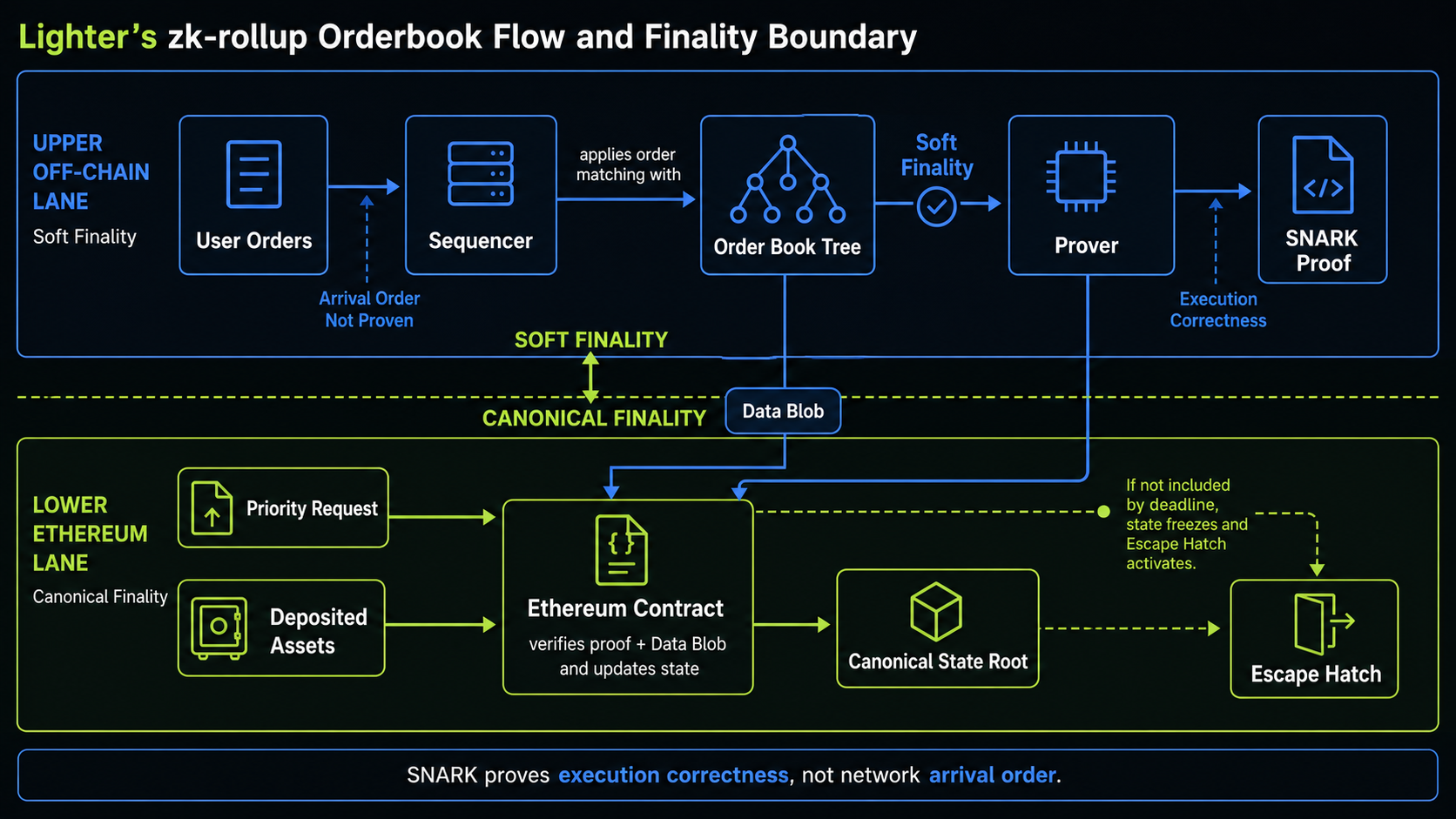
The SNARK proves execution correctness, not network arrival order, and canonical finality begins only after Ethereum verification.
How Lighter Fits Against Hyperliquid
Both Lighter and Hyperliquid run price-time priority orderbooks rather than AMMs, and both target CEX-level trading experience. The difference is in where verification happens.
Hyperliquid runs its own L1 with HyperBFT consensus. Every order, cancel, trade, and liquidation inherits one-block finality from that consensus layer. The official docs state support for 200,000 orders per second.
Lighter stays on Ethereum. A sequencer provides fast execution and soft finality. A prover generates SNARK proofs for exchange operations. Ethereum smart contracts hold deposited assets, verify proofs, and store canonical state roots. Users can force-include transactions via Ethereum directly, and if the sequencer fails to process them within a deadline, an Escape Hatch activates.
Different trust models. Lighter’s bet is that Ethereum settlement and verifiable proofs provide stronger exit guarantees than a separate L1 consensus.
Core Components
Sequencer
The sequencer is the low-latency execution engine. It processes user transactions in order, assembles them into blocks or batches, and feeds transaction receipts and state changes to the indexer and prover. According to the technical documentation, both priority requests and regular orders go through a first-come, first-served (FIFO) queue. Users see soft finality immediately; canonical state only finalizes after the Ethereum proof is verified.
Prover and Execution Proof
The prover takes the sequencer’s execution feed, the previous state, and the current transaction batch as inputs. It then generates correctness proofs for order matching, risk checks, account updates, and liquidations.
One thing worth clarifying: Lighter’s use of zk-SNARKs focuses on execution correctness, not zero-knowledge privacy. The proofs attest that state transitions were computed according to published rules, efficiently enough to verify on Ethereum. The Lighter whitepaper is explicit about this framing.
Order Book Tree
Proving orderbook matching inside a SNARK requires a specialized data structure. Lighter uses an Order Book Tree where internal nodes aggregate order data from child leaves, and leaf indices encode order priority in a prefix-tree-like scheme. The goal is to reduce per-matching-operation proof costs compared to a generic Merkle tree.
Ethereum Anchoring and Data Blobs
The Ethereum smart contract holds deposited assets and the canonical Lighter state root. Each state update proposal comes with a proof and an Ethereum data blob. The blob contains the minimum data needed for any user to independently reconstruct and verify their account state. After proof verification, the canonical root updates.
Priority Requests and Escape Hatch
Users can submit priority transactions directly through the Ethereum smart contract, bypassing the sequencer. If the sequencer does not include a priority transaction within a set deadline, the exchange state freezes and the Escape Hatch activates. This mechanism is primarily a withdrawal and censorship-resistance guarantee, not a general front-running prevention layer.
What the ZK Proof Actually Guarantees
“ZK proofs make front-running impossible” is an overstatement. The Lighter whitepaper describes the goal as “substantially reducing” MEV, and lists fair sequencing, transaction encryption, and pre-commitment schemes as future directions.
The SNARK proves that a state transition was computed correctly according to published matching rules. It does not prove the actual network arrival order of transactions, or that the sequencer observed them in any particular sequence. The FIFO policy is documented, but verifying actual order arrival fairness requires separate mechanisms.
So the accurate claim is: Lighter’s architecture structurally limits operator manipulation of matching, priority changes, and certain MEV incentives. “Substantially reduces MEV risk” is correct. “Front-running is impossible” is not.
Performance Numbers
From the Lighter API account types documentation:
- Standard Account: maker/cancel 200ms, taker 300ms, 0% fees
- Plus Account: maker/cancel 200ms, taker 300ms, 0.5bps fees
- Premium Account: maker/cancel 0ms, taker 200ms (down to 140ms depending on LIT stake)
The official site claims tens of thousands of orders and cancels per second with millisecond latency. Actual latency depends on account tier, staking level, network conditions, and API routing.
Open Questions
Lighter’s design is coherent, but several things need independent verification: trading volume, open interest, active user counts, and market depth. The gap between soft finality and Ethereum proof finality is a real operational consideration. By construction, canonical state only settles after proof verification, so fills that exist only at soft finality are not yet backed by Ethereum. Data availability is also worth watching: Lighter compresses blob data to reduce costs, posting only what is needed for state reconstruction rather than full transaction detail.
Further Reading
- Hyperliquid Docs: the L1-based orderbook approach for comparison
- Lighter Whitepaper: full zk-rollup orderbook design
- Lighter Technical Architecture: sequencer, prover, and contract structure
References
- Lighter Official Site: lighter.xyz, accessed 2026-06-30
- Lighter Docs: official technical documentation, accessed 2026-06-30
- Lighter Technical Architecture: accessed 2026-06-30
- Order Types & Matching: accessed 2026-06-30
- Lighter API Account Types: accessed 2026-06-30
- Lighter Whitepaper: accessed 2026-06-30
- Hyperliquid Docs: accessed 2026-06-30