Chainlink CCIP EVM Contracts: Architecture from Source Code
- whackur
- Blockchain
- June 30, 2026
- Updated: August 31, 2026
Table of Contents
EVM chains are isolated by design. A contract on Arbitrum has no native way to call a contract on Base, and sending USDC from Ethereum Mainnet to Polygon is not a built-in operation. Cross-chain bridges filled that gap for years, but the category has seen repeated security incidents that highlight how wide the attack surface is.
Chainlink CCIP (Cross-Chain Interoperability Protocol) applies Chainlink’s DON infrastructure and an independent Risk Management Network to the problem. It supports arbitrary data payloads alongside token transfers and lets you combine both in a single transaction. This post walks through the EVM contracts: what each one does, how they connect, and what matters when you are building on top of them.
Overall architecture
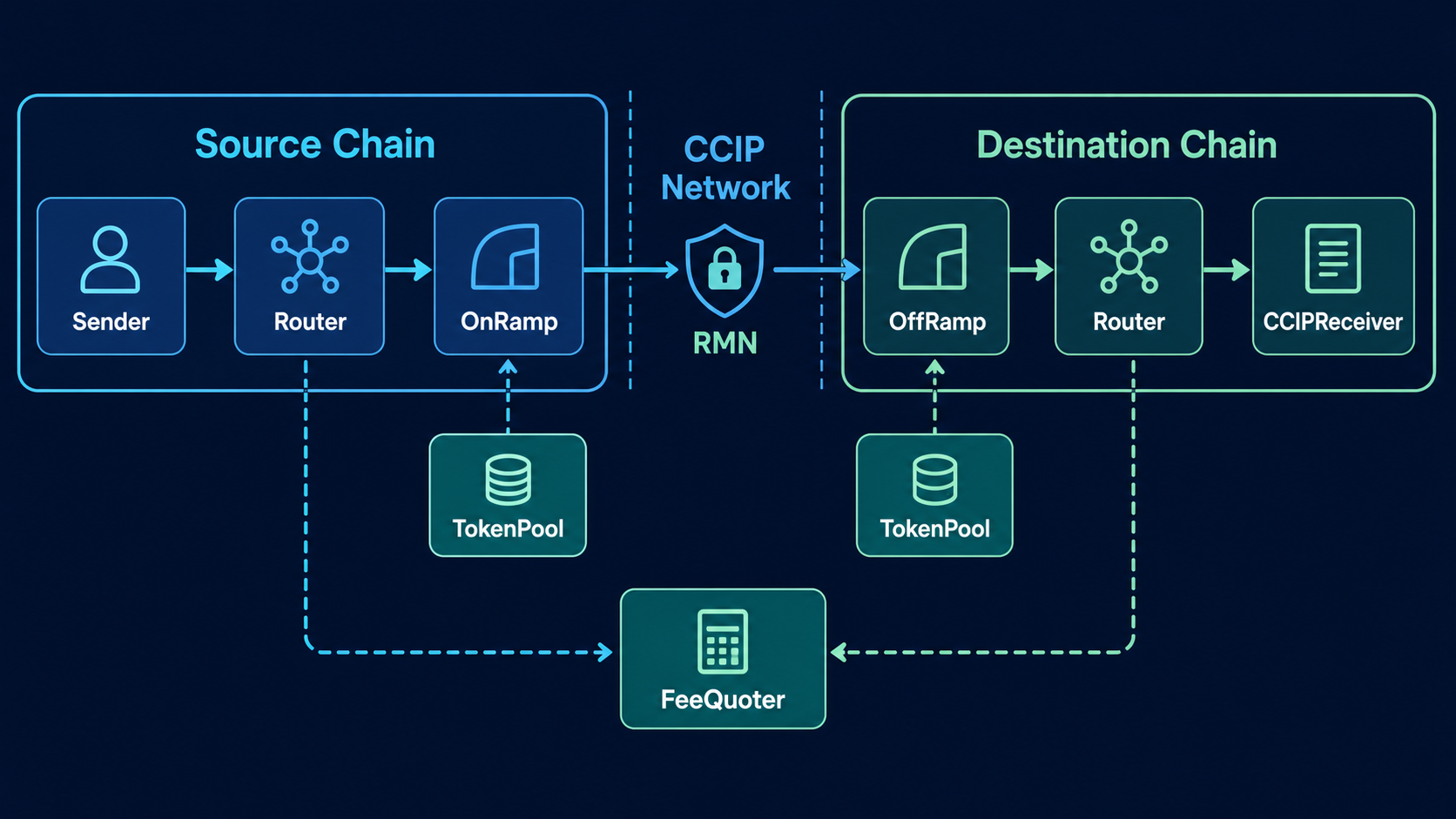
A message moves through the source Router and OnRamp, crosses the CCIP network, then reaches CCIPReceiver through the destination OffRamp and Router.
CCIP contracts split into two layers. The interface layer is what users and dApps touch directly. The pipeline layer is what the DON operates behind the scenes.
Users only ever call the Router. Router hands off to OnRamp on the source chain. The DON and offchain executors observe the CCIPMessageSent event and submit execution data to OffRamp.execute(encodedMessage, ccvs, verifierResults, gasLimitOverride) on the destination chain. OffRamp calls ccipReceive on the receiver contract, and the cycle is done.
| Contract | Chain | Role |
|---|---|---|
| Router 1.2.0 | source + destination | User entry point, routes by chain selector |
| OnRamp 2.0.0 | source | Validates outbound messages, locks/burns tokens, emits events |
| OffRamp 2.0.0 | destination | Verifies via CCVs, executes inbound messages, tracks state |
| TokenPool | source + destination | Lock/burn (source), release/mint (destination) |
| FeeQuoter 2.0.0 | source | Computes cross-chain fees |
| RMN 2.0.0 | source + destination | Blocks execution when anomalies are detected |
| TokenAdminRegistry 1.5.0 | source + destination | Token address to TokenPool address mapping |
Client message structs
The Client.sol library defines the message format. Send and receive use different structs.
Sending: EVM2AnyMessage
struct EVM2AnyMessage {
    bytes receiver;             // abi.encode(address) — bytes to support non-EVM chains
    bytes data;                 // arbitrary payload
    EVMTokenAmount[] tokenAmounts;
    address feeToken;           // address(0) = native gas token (ETH, etc.)
    bytes extraArgs;            // encoded EVMExtraArgsV1 or V2
}
receiver is bytes rather than address because CCIP targets non-EVM chains (Solana, etc.) as well. For EVM-to-EVM transfers, encode it as abi.encode(receiverAddress).
extraArgs carries the gas limit for executing ccipReceive on the destination and an ordering flag. Client.sol defines EVMExtraArgsV1 (gas limit only) and the multi-chain GenericExtraArgsV2; the v2 pipeline internally uses GenericExtraArgsV3, which adds CCV and executor fields.
// GenericExtraArgsV2 (tag: 0x181dcf10): recommended for standard EVM sends
struct GenericExtraArgsV2 {
    uint256 gasLimit;                  // gas for receiver's ccipReceive call
    bool allowOutOfOrderExecution;     // if true, out-of-order execution allowed
}
Set gasLimit too low and the execution reverts on the destination chain. Set it far higher than needed and you overpay, since the fee scales with the gas limit. Use GenericExtraArgsV2 explicitly rather than relying on defaults; the default can change across versions.
Receiving: Any2EVMMessage
struct Any2EVMMessage {
    bytes32 messageId;
    uint64 sourceChainSelector;
    bytes sender;              // abi.encode(address) — decode to get the address
    bytes data;
    EVMTokenAmount[] destTokenAmounts;
}
Recover the sender address with abi.decode(message.sender, (address)).
Router: the send surface
Router is the only CCIP contract your code calls directly. The interface is IRouterClient.
interface IRouterClient {
    function getFee(
        uint64 destinationChainSelector,
        Client.EVM2AnyMessage memory message
    ) external view returns (uint256 fee);

    function getSupportedTokens(uint64 chainSelector)
        external view returns (address[] memory tokens);

    function isChainSupported(uint64 chainSelector)
        external view returns (bool supported);

    function ccipSend(
        uint64 destinationChainSelector,
        Client.EVM2AnyMessage calldata message
    ) external payable returns (bytes32 messageId);
}
Before calling ccipSend:
- If
feeTokenis LINK,approvethe Router to spend LINK. - If
tokenAmountscontains tokens,approvethe Router for each. - If
feeToken == address(0), pass the fee asmsg.value.
getFee is a view function, so you can read it off-chain without a transaction. Because the price can shift between the getFee call and ccipSend, add a ~10% buffer to your approval or msg.value.
Internally, Router looks up the OnRamp registered for destinationChainSelector and calls forwardFromRouter.
OnRamp: outbound pipeline
OnRamp validates outbound messages, processes token locks or burns, and emits the event the DON monitors.
When forwardFromRouter is called, OnRamp runs these steps in order:
- RMN curse check: checks whether the destination chain is cursed. Reverts immediately if it is.
- Message validation: checks
tokenAmountscount, data size,extraArgsversion, andgasLimitbounds. - CCV list merge: combines user-specified, lane-mandated, and pool-required CCVs, then computes fees.
- Fee handling: distributes fees to each CCV, pool, executor, and the protocol network fee.
- Token processing: queries
TokenAdminRegistryfor each token’s pool, then callslockOrBurn(one token per message). - Message number: increments
DestChainConfig.messageNumberfor the destination chain. - Event emission: emits
CCIPMessageSentwith the messageId, messageNumber, encoded message, and receipt array.
The DON picks up the CCIPMessageSent event and starts the execution pipeline on the destination.
OffRamp: inbound pipeline
OffRamp lives on the destination chain. In CCIP v2, a single OffRamp instance handles messages from multiple source chains.
function execute(
    bytes calldata encodedMessage,
    address[] calldata ccvs,
    bytes[] calldata verifierResults,
    uint32 gasLimitOverride
) external;
execute is permissionless: anyone can call it. The DON’s Execute Plugin handles the normal flow.
Execution steps:
- RMN curse check: if
rmnRemote.isCursed(sourceChainSelector)is true, revert immediately. - Source chain validation: checks that the source chain is enabled, the onRamp address hash is recognized, the offRamp address matches, and the destination chain selector is correct.
- Execution state check: only
UNTOUCHEDorFAILUREmessages can proceed.SUCCESSis final. - CCV quorum:
_ensureCCVQuorumIsReachedverifies that all required CCVs are present. - CCV verification: calls each CCV’s
verifyMessageto check signatures. - Token release/mint: if tokens are attached, calls
releaseOrMinton the TokenPool. - Receiver call: for non-token-only transfers, calls
receiver.ccipReceive(message)within thegasLimitviarouter.routeMessage. - State update: records
SUCCESSorFAILURE.
Execution state uses MessageExecutionState: UNTOUCHED(0), IN_PROGRESS(1), SUCCESS(2), FAILURE(3). Failed messages can be retried via manuallyExecute.
TokenPool: four modes of token handling
TokenPool handles token movement across chains. The abstract base class TokenPool.sol defines the shared interface; four concrete implementations handle different token designs.
The pool interface:
function lockOrBurn(Pool.LockOrBurnInV1 calldata lockOrBurnIn)
    external returns (Pool.LockOrBurnOutV1 memory);

function releaseOrMint(Pool.ReleaseOrMintInV1 calldata releaseOrMintIn)
    external returns (Pool.ReleaseOrMintOutV1 memory);
LockReleaseTokenPool: locks tokens on the source chain and releases them on the destination. Total supply stays constant across both chains. For tokens that were originally deployed on one chain only (WBTC, for example).
BurnMintTokenPool: burns on source, mints on destination. The token must exist natively on multiple chains, and the pool contract must have mint authority on the destination.
BurnWithFromMintTokenPool: burns using a transferFrom + burn sequence. For token contracts that do not support burnFrom directly but do allow a pool to move and burn with explicit allowance.
BurnFromMintTokenPool: burns by calling burnFrom directly. Requires the token contract to support burnFrom and the pool to hold an allowance.
Which mode to pick depends on the token contract’s design and where mint authority lives. External bridged tokens typically use LockRelease; tokens purpose-built for multi-chain use BurnMint.
Rate limiting
Every TokenPool can configure inbound and outbound rate limits per chain. The token bucket algorithm caps how much value can move per unit time. Exceeding the limit causes a revert. The limits are configurable on-chain by the pool administrator.
FeeQuoter: fee computation
FeeQuoter took over from PriceRegistry in v1.5. It computes cross-chain fees and holds the price data the rest of the system uses.
A cross-chain fee has three parts:
- Network fee: a fixed protocol cost.
- Destination gas cost:
extraArgs.gasLimit × destination gas price, converted into the source chain’s fee token. - Token transfer fee: per-token fee based on amount and token configuration.
The DON updates price data periodically. FeeQuoter 2.0.0 removed the stale price revert check. Price freshness is now the DON’s responsibility rather than a hard on-chain guard.
RMN: Risk Management Network
RMN is CCIP’s independent security layer. A separate set of nodes (distinct from the DON) monitors both the source and destination chains.
If nodes detect anomalies such as chain reorganizations or abnormally large outflows, they vote to curse a lane or an entire chain.
interface IRMNRemote {
    function isCursed() external view returns (bool);
    function isCursed(bytes16 subject) external view returns (bool);
    function verify(
        address offRampAddress,
        Internal.MerkleRoot[] memory merkleRoots,
        Internal.SignedMerkleRoot[] memory signatures,
        uint256 rawVs
    ) external view;
}
The subject parameter in isCursed(bytes16 subject) is a combination of the source chain selector and lane identifier. OffRamp checks this at the start of every execution call and reverts if cursed.
verify is called internally by OffRamp as part of message verification through CCVs (verifyMessage). Router, OnRamp, OffRamp, and TokenPool all check RMN curse state directly via isCursed and revert immediately if a curse is active. This means even if the DON were compromised, RMN can still block execution independently.
In v2, each chain has a deployed RMNRemote that verifies signatures locally, while a remote RMNHome manages the RMN node set configuration.
CCIPReceiver: the receiver contract pattern
Any contract that receives CCIP messages must implement IAny2EVMMessageReceiver. Extending Chainlink’s CCIPReceiver abstract contract takes care of the plumbing:
abstract contract CCIPReceiver is IAny2EVMMessageReceiver {
    address internal immutable i_ccipRouter;

    modifier onlyRouter() {
        if (msg.sender != i_ccipRouter) revert InvalidRouter(msg.sender);
        _;
    }

    function ccipReceive(Client.Any2EVMMessage calldata message)
        external virtual override onlyRouter
    {
        _ccipReceive(message);
    }

    function _ccipReceive(Client.Any2EVMMessage memory message) internal virtual;
}
The onlyRouter modifier is what actually matters here. ccipReceive must only accept calls from the Router. Skip this check and anyone can call your contract with an arbitrary message.
Beyond that, a few patterns are worth enforcing:
Sender validation: decode message.sender and check it against a whitelist of trusted source chains and sender addresses. Reject anything unexpected.
Idempotency: if _ccipReceive can be called twice for the same messageId (via manuallyExecute), make sure the second call does not double-apply state changes.
Duplicate execution guard: track processed messageIds. Be aware that returning early without reverting marks the message as SUCCESS, which prevents future retries.
Revert behavior: if _ccipReceive reverts, OffRamp records the message as FAILURE. A manuallyExecute retry will run the same logic under the same gas limit, so investigate the root cause before retrying.
Message ordering
Message ordering in v2 is managed through DestChainConfig.messageNumber in OnRamp and s_executionStates in OffRamp. There is no separate NonceManager contract.
The allowOutOfOrderExecution flag and finality/ordering policy are encoded in extraArgs and lane configuration. Check the Chainlink documentation and CCIP Directory for the actual behavior on specific lanes. When allowOutOfOrderExecution is false, messages from the same sender to the same destination chain execute in order. If message N fails, message N+1 stays in UNTOUCHED state until N is resolved.
Setting allowOutOfOrderExecution to true skips the ordering check. This is fine for standalone token transfers or any case where order genuinely does not matter.
For workflows where order is load-bearing (sequential payments, state machine transitions), keep the default and design an explicit recovery path for the case where an earlier message stays FAILURE.
Integration checklist
Items to verify before going to production.
Approvals
- Router approved to spend LINK (if using LINK as fee token)
- Router approved to spend each transfer token
-
isChainSupported(destChainSelector)returns true - Transfer tokens confirmed in
getSupportedTokens(destChainSelector)
Fees
-
getFeeresult plus buffer (~10%) used for approval amount ormsg.value
Receiver contract
-
onlyRoutermodifier onccipReceive -
sourceChainSelectorand sender address whitelist checked - messageId-based duplicate execution guard
-
_ccipReceivelogic is idempotent -
extraArgs.gasLimitis large enough for the receiver’s actual gas usage
Error recovery
- An EOA or multisig has authority to call
manuallyExecutefor failed messages - Plan for token state if execution fails after
lockOrBurnbut beforereleaseOrMint
Testing
- End-to-end test on testnet using Chainlink’s
CCIP-BnMburn-and-mint test token - Router address upgrade path accounted for in contract design
Further reading
- Chainlink CCIP Documentation — architecture, API reference, supported networks
- CCIP Source Code (smartcontractkit/chainlink) — Router, OnRamp, OffRamp, TokenPool implementations
- CCIP Hardhat Starter Kit — send and receive example contracts
- CCIP Explorer — cross-chain message tracker
- CCIP Best Practices — official guidance on security and integration patterns
References
- Chainlink CCIP Architecture — docs.chain.link, accessed 2026-06-30
- Chainlink CCIP API Reference — docs.chain.link, accessed 2026-06-30
- Chainlink CCIP Best Practices — docs.chain.link, accessed 2026-06-30
- CCIP Supported Networks — docs.chain.link, accessed 2026-06-30
- CCIP Source Code (smartcontractkit/chainlink) — github.com/smartcontractkit, accessed 2026-06-30
- CCIP Starter Kit (Hardhat) — github.com/smartcontractkit, accessed 2026-06-30