AI x Blockchain in 2026: Bittensor, DePIN, and Agent Finance
- whackur
- Blockchain
- June 30, 2026
- Updated: August 31, 2026
Table of Contents
“AI plus blockchain” spent most of the early 2020s as a marketing phrase. By mid-2026, it has organized into four distinct layers, each with its own competitive dynamics. Which projects have staying power, and what are the actual evaluation criteria at this point?
This post maps the landscape as of June 2026, drawing on public project documentation and official sources. Time-sensitive figures like token prices, trading volumes, and GPU counts should be verified against live sources before any decision-making.
The Map
| Layer | Representative Projects |
|---|---|
| Intelligence | Bittensor, OpenGradient, Chutes, AskVenice |
| Compute | Akash, Render, Aethir, io.net |
| Coordination / Data | Fetch.ai/ASI, NEAR, Ocean |
| Agent Finance / DeFAI | ARMA, Infinit, Coinvest, Virtuals, x402 |
| Infrastructure / Training | Prime Intellect, Gensyn, Nous Psyche, Tplr |
Bittensor: The Current Reference Point for Decentralized AI Incentives
Bittensor describes itself as a marketplace for intelligence. Miners (AI service providers) produce outputs; validators (quality scorers) assess them; and Yuma Consensus aggregates those scores on-chain to distribute TAO (Bittensor’s native token) as emission rewards. The terms “miner” and “validator” here describe functional roles, not proof-of-work mining or proof-of-stake validation. Over 128 subnets are currently active, each functioning as a separate AI task market with its own miners, validators, incentive rules, and service demand.
How Yuma Consensus Works
Yuma Consensus aggregates validator weights using stake as the basis, but clips excessive concentration and rewards validators whose assessments land close to consensus. This makes it harder for a small number of large validators to dominate rewards.
Proof-of-Utility replaces hash power with “useful output” as the reward criterion. That design should, in theory, push quality improvements across the ecosystem. In practice, quality variance between subnets and incentive gaming remain real issues.
What TAO Actually Is
TAO behaves less like a single-service token and more like an index over a distributed AI ecosystem. The top subnets handle different workloads: text and knowledge tasks, advanced inference, high-performance compute. Each subnet is effectively its own market.
Understanding that index-like character requires the dTAO (Dynamic TAO) upgrade, activated in February 2025. Since dTAO, each subnet issues its own alpha token, and per-subnet TAO emissions track the market price of those alpha tokens instead of root validator weight votes. Which subnets earn more is decided by the market, not by a small set of validators. Holding TAO now means holding exposure to the whole subnet portfolio rather than to any single service.
The risks to watch: per-subnet quality and demand variance, operational difficulty for miners and validators, emission concentration, and direct price and quality competition from centralized AI APIs. In young subnets with thin alpha token markets, gaming emissions through price manipulation is structurally possible, so subnet metrics should be read together with liquidity depth.
Four Decentralized Compute Projects
DePIN (Decentralized Physical Infrastructure Networks) is a model where physical hardware, including GPU servers, wireless equipment, and storage devices, is pooled and governed through token incentives rather than owned by a single provider. Hardware owners contribute idle capacity and earn token rewards; buyers access that capacity at market prices. GPU DePIN applies this to AI compute: instead of renting from AWS or Google Cloud, workloads run on a distributed network of independent GPU providers worldwide.
Akash, Render Network, Aethir, and io.net all tokenize GPU supply, but they serve different customers with different pricing models.
Akash is a Cosmos-based decentralized cloud marketplace for developers and AI startups. It uses a reverse-auction model: buyers post the compute specs and price they want, and GPU providers bid to fulfill the request. Docker-native support and Ray cluster integration make it straightforward to migrate existing workloads. The main concerns are supplier concentration and availability variability.
Render Network started with 3D rendering workflows (OctaneRender, Blender, Runway) and is extending into AI image and video workloads. The strength is that demand is tied to work that generates actual revenue. Dependence on the creator market is the main constraint.
Aethir sells bare metal GPU and edge compute to enterprise AI and gaming studios on compute credit and contract terms. Stable, but sales cycles are long.
io.net positions around fast Solana-based settlement and a global GPU pool. Of the four, it has the most ground to cover in demonstrating real-world demand and ecosystem depth.
Picking between them: GPU count is less informative than actual inference and training cost per workload, measured against centralized cloud alternatives. Raw GPU counts are easy for suppliers to inflate, and the same GPU delivers very different effective performance depending on network bandwidth, container scheduling, and how the network handles reassignment after a node failure.
Agent Finance and DeFAI
The emerging category called DeFAI (Decentralized Finance + AI) covers AI agents that independently handle trading, strategy execution, and task completion. Projects like ARMA, Infinit, Coinvest, and Virtuals operate here.
The hard problem in this layer is delegation, not yield. Giving an agent authority to move funds means defining spending limits, callable scopes, and failure liability at the code level. A good strategy is worth little if the agent holding the keys has sloppy permission boundaries.
The evaluation standard is shifting accordingly. Whether a project has a token matters less than whether it has recurring transaction volume, real demand, actual execution workload, and permission controls that outsiders can audit. That filter removes a lot of noise.
x402: Machine-to-Machine Payments
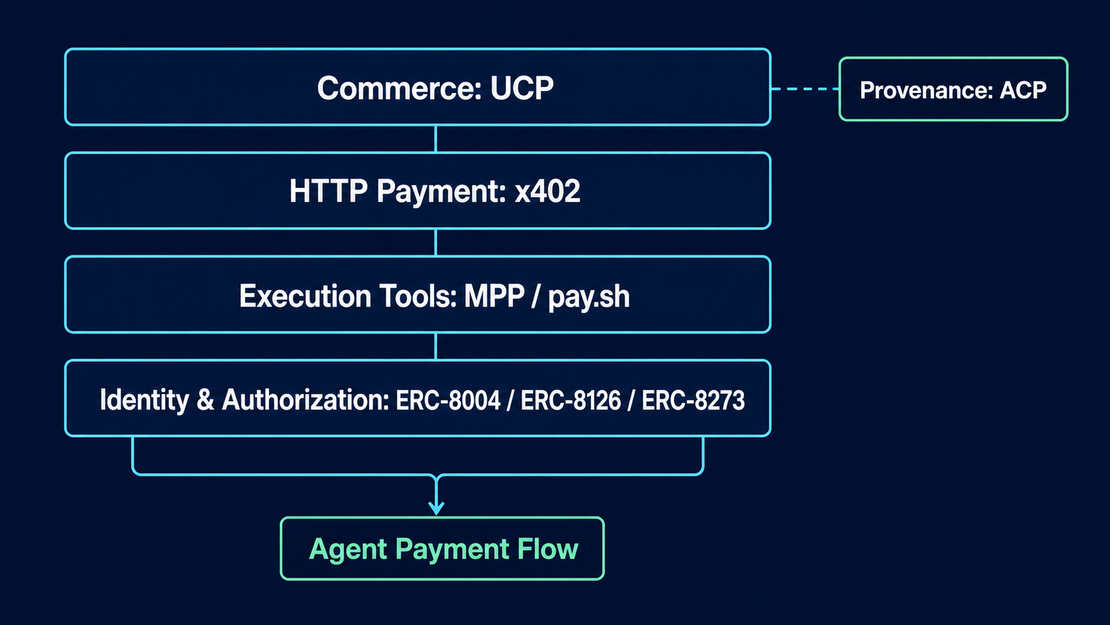
x402 is a machine-to-machine payment protocol that puts the long-dormant HTTP 402 Payment Required status code to work. Coinbase published it as an open protocol. It lets AI agents pay for API access, tools, and data at the moment of invocation, with no human registering a card or managing a subscription.
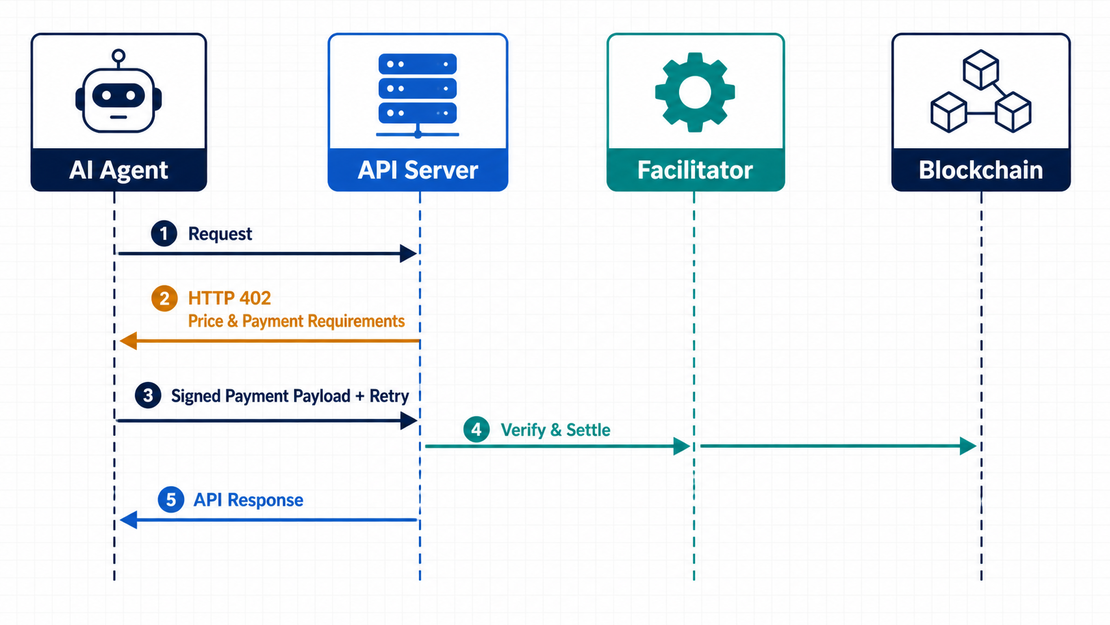
The flow embeds payment into the HTTP request-response cycle. An agent calls a paid endpoint, the server answers with a 402 response carrying the price and payment requirements, and the agent retries with a signed payment payload attached. A facilitator service handles on-chain verification and settlement, so the API server can accept stablecoin payments without running wallet infrastructure of its own.
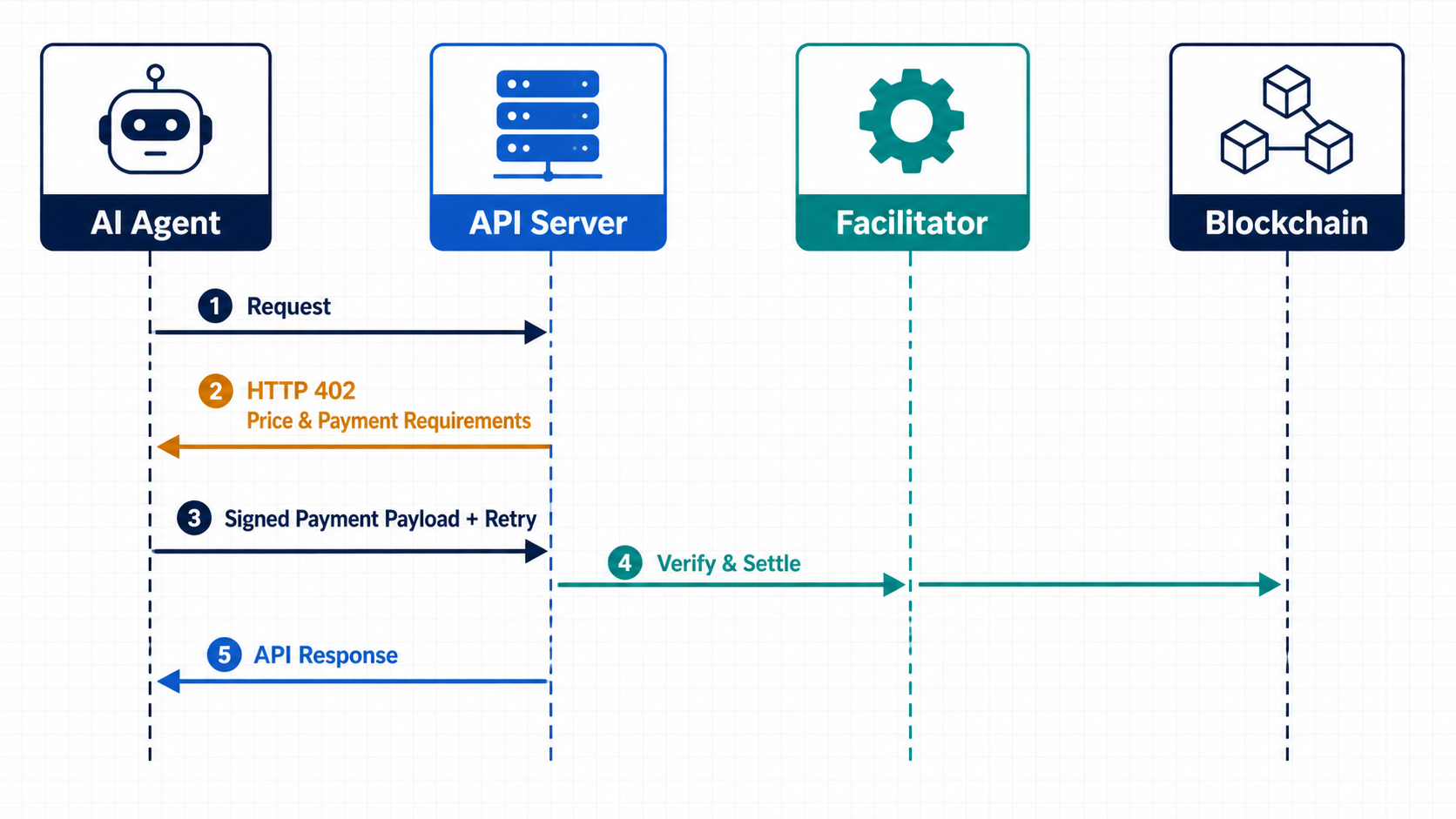
Diagram reconstructed from the x402 request, payment, verification, and settlement flow described in this article.
What sets x402 apart in practice is that payment, settlement, and authorization travel in one flow. In MCP server architectures where one agent calls another agent’s paid API, x402 carries the payment chain through each layer. Attribution and settlement for multi-hop service calls is a real design challenge, and x402’s builder-code system addresses it by tagging each intermediary in the call chain. Payment handling is turning into a piece of agent infrastructure in its own right.
What to Actually Watch
Across all four layers, the useful signals are:
- Bittensor: actual workload volume per subnet, miner quality distribution, alpha token liquidity depth
- Decentralized compute: real inference and training costs benchmarked against centralized cloud
- Agent finance: recurring execution volume, sustained demand, and auditable permission controls
- x402: payment transactions per API call and settlement reliability at scale
A token proves nothing by itself. The deciding test in 2026 is whether the infrastructure behind it is handling real AI workloads.
Further Reading
- Bittensor: decentralized AI incentive layer
- Akash Network: developer-focused distributed GPU cloud
- Render Network: creator and AI rendering marketplace
- io.net: Solana-based GPU rental
- x402 Protocol: machine-to-machine payment standard
References
- Bittensor: bittensor.com, accessed 2026-06-30
- Akash Network: akash.network, accessed 2026-06-30
- Render Network: rendernetwork.com, accessed 2026-06-30
- Aethir: aethir.com, accessed 2026-06-30
- io.net: io.net, accessed 2026-06-30
- x402 Protocol: x402.org, accessed 2026-06-30