Blog Posts
- Home /
- Blog Posts

Ethereum Glamsterdam Upgrade: ePBS, BALs, Every EIP and Operational Changes
- whackur
- Blockchain
- October 17, 2026
Glamsterdam aims to expand Ethereum L1 capacity by changing both how blocks are built and how receiving nodes validate them. Enshrined proposer-builder separation (ePBS) brings commitments, payload reveals and proposer payments into the protocol. Block-level access lists (BALs) carry actual state accesses and post-transaction changes so receiving nodes can parallelize reads and validation. Gas repricing and networking changes support that effort. These changes do not guarantee lower fees for every transaction or a particular TPS figure. EIP-7773 defines the scope; EIP-7732 and EIP-7928 define the two central mechanisms.
Read More
Technology Moats in the AI Era
Building software and making money are different things I recently attended an AI conference. As I looked at the many products and demonstrations, one question kept coming back to me.
Read More
Data Enclosure and Platform Concentration in the AI Era
Data enclosure in the AI era is about platforms deciding who may reuse data, and for what purpose. Some end APIs; others supply selected AI companies under contract or charge for usage. These cases show access conditions being reorganized. They do not, by themselves, establish monopoly or unlawful conduct by any company.
Read More
Transferring Tokens with Canton Daml: State and Authorization Compared with Solidity
- whackur
- Blockchain
- October 15, 2026
When Alice sends all 100 token units to Bob, Bob becomes the person who can spend them next. The Solidity example updates balances by address; the Daml example for Canton consumes Alice’s holding contract and creates Bob’s. They express the same transfer outcome with different units of state and different authorization checks.
Read More
Understanding Besu: From Ethereum Execution to Bank Token Payments
- whackur
- Blockchain
- October 15, 2026
Besu is a Java Ethereum client that executes smart contracts and verifies and stores their results. Banks can use it to build a ledger that handles deposit tokens alongside interbank settlement assets. It also serves as an execution client on Ethereum mainnet. These deployments share execution technology, while the issuers of money and the parties that finalize the ledger depend on the network. Besu documentation
Read More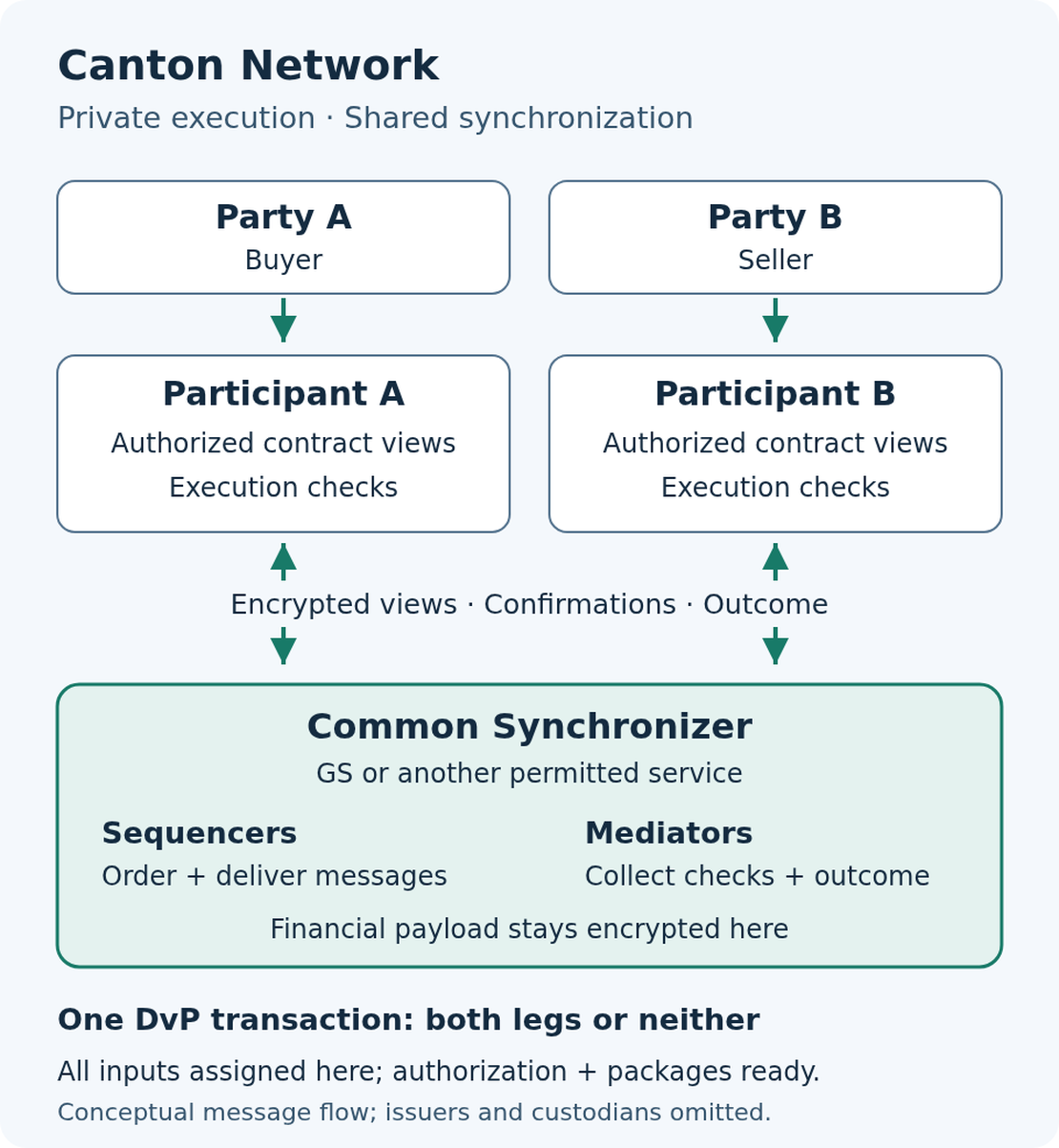
Understanding Canton Network: Financial Privacy, Atomic Settlement, and Institutional Adoption
- whackur
- Blockchain
- October 15, 2026
Buying a security changes records in several places. A trading venue records the execution, a custodian records the securities position, and a bank maintains the cash ledger. Each institution has its own account of the transaction. Reconciliation checks that amounts, rights, and processing states agree. A single public database might appear to simplify the problem, but institutions cannot publish their customers’ balances and trading strategies to everyone operating the infrastructure.
Read More
Glamsterdam's New Gas Model: EIP-8037 State Gas, EIP-8038 Access Costs, EIP-2780 Intrinsic Gas
- whackur
- Blockchain
- October 15, 2026
Glamsterdam’s three gas proposals make new persistent state more expensive and raise the cost of updating existing state, while lowering the base cost of some transactions that do less work. A fresh cold storage write has specified components of 12,100 execution gas plus 97,920 state gas; the first cold change away from an existing slot’s nonzero transaction-start value costs 12,100 execution gas and no state gas. Both still draw on the transaction’s single gasLimit, but gasleft() does not report the separate state-gas reservoir. These are specification costs, not measured Solidity function totals or an announcement that the rules are active on mainnet. EIP-8037, EIP-8038 and EIP-2780 define the changes together.
Read More
Why did Anthropic publish its report on alleged Kimi-to-Claude routing?
If sensitive information was reaching Claude, why would Anthropic reveal the route? A model provider may gain more from limiting unauthorized use and alerting customers to a data-handling problem than from continuing to observe the inputs. Answering a competitor’s users consumes compute and may produce training material for that competitor. Publication also reaches users and enterprise buyers whom account bans alone cannot inform. These incentives explain why disclosure can make sense; they do not establish how Anthropic made its internal decision.
Read More
SwarmWorld: LLM Agents That Cooperate Without Talking, and Technology That Outlives Them
In SwarmWorld, agents can continue one another’s work without talking by observing persistent devices and changes to their shared environment. That shared world helped them build collections of technologies serving several functions, but did not guarantee the best individual device. The MIT researchers’ paper demonstrates collaboration through accumulating functional artifacts inside a specified simulator. It does not establish the invention of real materials or a universal advantage for real-world multi-agent systems.
Read More
Know Your Agent (KYA): AI Agent Identity, the Standards Race, and What Is Actually On-Chain
- whackur
- Blockchain
- August 27, 2026
An identity credential or an on-chain registration number is insufficient grounds to let an AI agent spend money or access data. Identifying the agent, authenticating the requester, checking its authority for this action, and deciding how much to trust past feedback are separate checks. Know Your Agent (KYA) groups these concerns under one name. ERC-8004 supplies identifiers and public trust signals; Visa TAP and identity-verification vendors offer other ways to check requests, organizations or people. The service receiving the request still decides whether to grant access. The ERC-8004 specification and Trulioo’s product description both limit what registration or verification establishes.
Read MoreTags
- A2a
- Act
- Agent
- Agent-Debate
- Agent-Finance
- Agent-Harness
- Agent-Skills
- Agentic-Payments
- Ai-Agent
- Ai-Agents
- Ai-Architecture
- Ai-Blockchain
- Ai-Research
- Ai-Search
- Ai-Security
- Akash
- Anthropic
- Apify
- Base
- Benchmark
- Besu
- Bitcoin
- Bittensor
- Block-Access-Lists
- Canton
- Capital-Markets
- Ccip
- Cctp
- Chainlink
- Circle
- Coding
- Coding-Agent
- Coinbase
- Commerce
- Competition
- Compliance
- Context-Engineering
- Cross-Chain
- Cryptography
- Daml
- Data
- Data-Enclosure
- Data-Licensing
- Decentralized-Compute
- Depin
- Dex
- Diffusion-Policy
- Distillation
- Eip
- Eip-2780
- Eip-3009
- Eip-8037
- Eip-8038
- Emergent-Behavior
- Ensemble
- Enterprise-Blockchain
- Epbs
- Erc-8001
- Erc-8004
- Erc-8041
- Erc-8126
- Erc-8183
- Erc-8196
- Erc-8226
- Ethereum
- Evals
- Evaluation
- Evm
- Execution-Client
- Fhe
- Fido2
- Fintech
- Gas
- Glamsterdam
- Goldman-Sachs
- Google-Cloud
- Gpt-5-6
- Groth16
- Harness
- Heloc
- Hermes-Agent
- Identity
- Imitation-Learning
- Institutional-Finance
- Kimi
- Knowledge-Management
- Kya
- Langfuse
- Langgraph
- Lerobot
- Llama-Cpp
- Llm
- Llm-Agents
- Llm-as-Judge
- Llm-Observability
- Local-Llm
- Maci
- Math
- Mcp
- Memory
- Metadata
- Mev
- Moa
- Model-Routing
- Moe
- Mpp
- Mtp
- Multi-Agent
- Observability
- Okf
- Onchain
- Open-Source
- Open-Standard
- Opik
- Orderbook
- Passkey
- Physical-Ai
- Platforms
- Post-Quantum-Cryptography
- Post-Training
- Privacy
- Prompt-Engineering
- Provenance
- Python
- Qbft
- Quant-Finance
- Quantum-Computing
- Qwen
- Rag
- Reasoning
- Reinforcement-Learning
- Render
- Reputation
- Retrieval
- Reverse-Kl
- Rl
- Robot-Learning
- Rwa
- Search-Agent
- Security
- Self-Improvement
- Semaphore
- Settlement
- Skills
- Small-Language-Model
- Smart-Contract
- Smart-Contracts
- Smolvla
- Snark
- Software
- Solidity
- Sp1
- Stablecoin
- Stigmergy
- Swe-Bench
- Tokenization
- Tracing
- Trading
- Tutorial
- Ucp
- Uncensored
- Usdc
- Validators
- Vla
- Voting
- Wallet
- Webauthn
- X402
- Ylds
- Zero-Knowledge
- Zk-Proof
- Zk-Rollup